ARTICLE · Revenue Growth Management
10x wasn't enough. He was right.

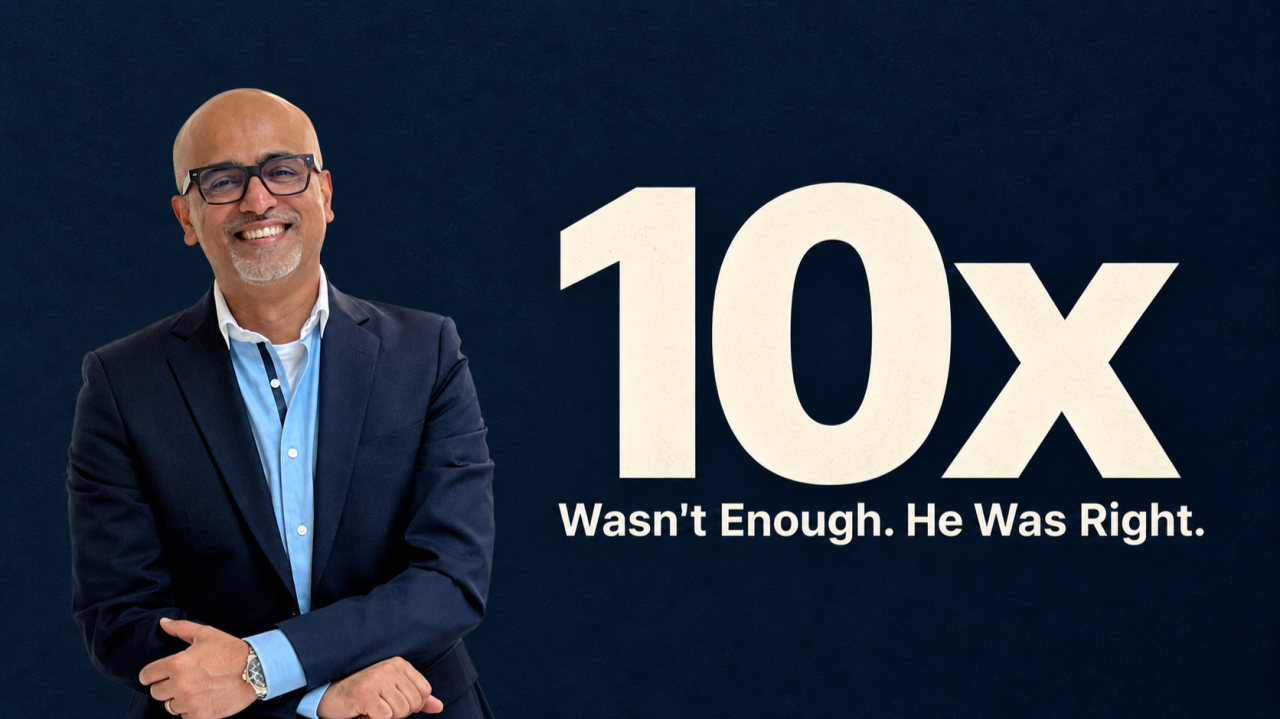
I offered a client a guarantee. For every dollar he put into the project, ten dollars back.
He turned it down.
Not because he thought it was risky. Because he thought it was not enough.
"Who said I'm going to be happy with 10x? I'm looking for 100x."
I laughed. I had been pursuing that business for the better part of seven months, through several meetings that went nowhere in particular, and I had walked into that one rather pleased with myself.
It took me a while to work out that he was telling me something about himself that I should have picked up much earlier. He had already sized the prize.
Nobody puts out a tender for a commercial consultant
There is no RFP in my line of work. No procurement process, no scoring matrix, no formal brief.
What happens is that a business has a problem, somebody picks up the phone to somebody they know, and within about two minutes the conversation lands in the same place.
"What are your rates?"
I used to answer that question. I have stopped, because I have come to think it is the wrong question asked at the wrong moment, and that both sides lose by starting there.
When you ask me for my rate, you are asking me to help you minimize a cost. That is an entirely sensible thing to do with a cost. The difficulty is that you are negotiating hard on the smallest number in the room, while the number that actually matters has not been mentioned at all.
Two kinds of client, and the difference is not size
Over the last few years I have noticed that clients divide fairly cleanly into two groups. The divide has nothing to do with the size of business or sophistication.
The first group has already sized the prize.
One of them came to me knowing exactly what they were after. They had looked back across several years of performance and found that their gross to net had slipped by 500 bpts. They knew what those basis points were worth in dollars. They had a reasonable idea of where it had gone: pricing that had drifted, trade terms agreed in one market condition and quietly renewed in another, promotional allowances that nobody had reopened in years.
What they did not know was how much of it was recoverable, and how quickly.
That client never asked me for a rate. They indicated what they were willing to pay.
That is a ten minute fee conversation. It is also the conversation in which somebody says 100x, because they are measuring my fee against a number they have already calculated themselves.
The second group cannot see the prize.
They know something is wrong. Volume is flat or in decline. Margin is drifting down. The budget conversation has become uncomfortable. But nobody has put a number on what is leaking, or where it is leaking from, or what it would be worth to stop it.
This is the part worth sitting with for a moment.
These are the businesses that need the work most. They are also the ones that find it hardest to buy. Not because they are careful with money, but because they have nothing to compare the fee against. Every quotation arrives as a pure cost, floating on its own, sitting next to a benefit that nobody has sized.
So they hesitate. Which is rational. And the leak continues.
The circularity nobody in my profession likes to say out loud
Value-based pricing requires the client to already know the value.
But in the businesses that are leaking most, finding the value is the first piece of the work. You cannot price against a number that does not exist yet, and the number does not exist precisely because nobody has done the job of producing it.
That is the trap, and it is why so many of these conversations quietly die.
It is also why my guarantee was worthless in Riyadh. I had promised a multiple to a man who had already calculated his own, and mine was too small. Offer the same guarantee to the second kind of client and it fails for the opposite reason. A promise of 10x means nothing to someone who has no idea what 1x is.
What I ask now instead
I have stopped leading with multiples. I have also stopped answering the rates question first.
The question I ask now is simpler, and it is usually uncomfortable.
What is the largest number in your business that you struggle with or are constantly debating in-house?
For most FMCG companies I work with, the answer sits inside the gross to net. The distance between the price on the invoice and the money that actually reaches the bottom line. Listing fees, promotional allowances, distributor margins, rebates, deductions that were negotiated once and have been renewing themselves ever since.
Almost every company reports that number.
Very few have ever taken it apart.
Before you ask anyone for a rate from a commercial consultant
Do this first, with your own team and your own data.
Take your gross to net line by line for the last three or four years. Not the total. The lines. Find the ones that have moved and that nobody around the table can fully account for.
If you can size that gap yourselves, you do not need a consultant to tell you what the prize is worth. You need someone to unpack it, and you already know what the ‘unpack’ is worth paying for.
If you cannot size it inside a fortnight, that is the finding.
And that is where the first piece of work belongs. Not a strategy. Not a transformation program.
This is the right moment in the year to ask that all important question as you make your plans for 2027.
Do you have a size of prize or are you still problem finding?
Tom Thomas, Managing Director
Tom has spent more than 30 years leading consumer businesses across the Middle East, Africa and Asia. Today he helps leadership teams grow revenue, improve profitability and put AI to work.